Research Article | | Peer-Reviewed

Factors Associated with the Occurrence of Human Rabies Cases in Mali, 2018-2022

Received: 24 August 2026     Accepted: 2 September 2026     Published: 24 September 2026
Views:       Downloads:
Abstract

Introduction: Rabies is transmitted by the saliva of infected animals on excoriated skin or mucous membranes. Data from the epidemiological surveillance sub-directorate of the General Directorate of Health and Public Hygiene show an upsurge in cases of human rabies from 3 in 2020 to 10 in 2022 and dog bites from 742 in 2020 to 1702 in 2022, hence this study with the objective of studying the factors associated with the occurrence of the disease in Mali. Methods: This is an analytical cross-sectional study of data from 2018 to 2022, that took place from February 1 to September 30, 2023. Study population was made up of any suspected case of dog of rabies recorded in the DGSHP database from 2018 to 2022. Pearson or Fisher Chi2 tests and a α cut-off of 0.05 allowed comparisons. Results: Cases of dog bites were 368 including 24 cases of human rabies, i.e. a frequency of 6.52%. Factors associated with rabies were: lesion severity (p = 0.0001), lack of lesion management (p = 0.0001), failure to clean lesions (p = 0.0001), failure to visit a health facility after the bite (p = 0.001), lack of post-exposure vaccination (p = 0.001), notification structure (p = 0.001), lack of rabies vaccination of biting dogs (p = 0.008), bite lesions (p = 0.039). Conclusion: Vaccination of dogs, adequate care and community awareness will reduce the occurrence of rabies.

Published in World Journal of Public Health (Volume 11, Issue 3)
DOI 10.11648/j.wjph.20261103.25
Page(s) 374-381
Creative Commons

This is an Open Access article, distributed under the terms of the Creative Commons Attribution 4.0 International License (http://creativecommons.org/licenses/by/4.0/), which permits unrestricted use, distribution and reproduction in any medium or format, provided the original work is properly cited.

Copyright

Copyright © The Author(s), 2026. Published by Science Publishing Group

Keywords

Rabies, Associated Factors, Mali, 2023

1. Introduction
Rabies is a highly lethal zoonosis caused by RNA viruses of the genus lyssavirus of the family Rhabdoviridae, order Mononegavirales. It is transmitted through the saliva of infected animals following a bite, scratching or licking on excoriated skin or mucous membranes .
The annual number of deaths worldwide due to rabies is estimated at 59,000 in 2015, the majority of which occur in Asia (59.6%) and Africa (36.4%) .
In sub-Saharan Africa, the case fatality rate, according to the World Health Organization (WHO), is 0.01 to 3 cases per 100,000 inhabitants .
In Mali, a retrospective study conducted in Bamako from 2000 to 2003 revealed 10 cases of rabies out of 5,870 cases of animal bites, i.e. 0.17%, with an annual average of 1,470. The lethality was 100% .
The fight against rabies in Mali is supported by legislative and regulatory provisions through Law No. 01-022 of 31 May 2001 governing the repression of offences against animal health in the territory of the Republic of Mali, Decrees No. 01-339/P-RM of 9 August 2001 laying down the modalities for the application of Law No. 01-022 of 31 May 2001 on the repression of offences against animal health in the territory of the Republic of Mali and No. 06-412/P-RM of 27 September 2006 amending Decree No. 01-339/P-RM of 9 August 2001 (Article 16 of which makes it compulsory to vaccinate the canine species against rabies, free of charge during the campaigns) . According to Decree No. 07-165/P-RM of 23 May 2007 establishing the list of compulsory diseases and the conditions of this declaration, rabies is included on the list of contagious diseases in Mali. It is one of the diseases that must be declared immediately (MADO/MADI). This fight is also reinforced by the organization of annual dog vaccination campaigns, the organization of World Rabies Day (celebrated September 28 each year), the free vaccination of people at risk, the care of bitten and exposed people, combined with the regular control of the stray dog population. The implementation of the One Health approach (intersectoral collaboration between human and animal health services, agriculture and the environment) is one of the best strategies for rabies control.
Despite the implementation of all these strategies, according to an observational study in a hospital setting carried out by Dembele JP et al. in Mali in 2020 , the hospital frequency of rabies was 1.16%. Data from the General Directorate of Health and Public Hygiene (DGSHP) show an upsurge in human rabies cases from 3 in 2020 to 10 cases in 2022 and cases of dog bites which increased from 742 in 2020 to 1702 in 2022 . We initiated this study with the objective of describing the socio-demographic characteristics, describing the management of cases and identifying the factors associated with the occurrence of rabies in Mali in 2023.
2. Materials and Methods
2.1. Scope of the Study
The framework of the study was made up of the regions and their health districts of Mali.
Mali has an area of 1,241,238 km2 and had nineteen (19) administrative regions, seventy-five (75) health districts. On the veterinary sector, it was made up of fifty-two (52) veterinary sectors, two hundred and seventy-two (272) veterinary posts and one hundred and sixty-five (165) agents . The human population was estimated at 21,726,000 in 2022 . The dog population was estimated at 22,5681 with 11,038 vaccinated subjects, or 4.9% of vaccinated subjects .
2.2. Type and Period of Study
We conducted an analytical cross-sectional study of data from 2018 to 2022, that took place from February 1 to September 30, 2023.
Study population: This was made up of any suspected case of dog of rabies recorded in the DGSHP database from 2018 to 2022.
Inclusion criteria: Any suspected case of a dog bite completely recorded in the DGSHP database from 2018 to 2022.
Criteria for non-inclusion: Any case of dog bite recorded in the DGSHP database from 2018 to 2022 for which the information is incomplete.
Sampling: This was an exhaustive sampling. All suspected cases of dog of rabies in Mali's health districts recorded in the surveillance database, including those confirmed, were included.
Data collection: Data were collected from a data extraction and primary media review form for confirmation and triangulation of data from the surveillance database.
2.3. Variables
Dependent variables: Occurrence of rabies (yes/no)
Independent variables: Sociodemographic characteristics (gender, age, origin, occupation); date of notification, date of bite, date of appearance of the first signs, structure of notification, nature of exposure, location of lesions, consultation in a health centre, removal of the piece by the veterinary service, management (anti-rabies vaccination of the case and the dog, washing of the wound, dressing, antibiotic therapy, number of doses of vaccine, serotherapy, Td), prognosis (cases of bites, biting animals)
2.4. Data Entry and Analysis
The data was entered into Excel and then analysed with Epi Info 7. The maps were produced from QGIS. The results were presented in the form of tables, figures and maps. Proportions were calculated for qualitative variables, the mean for quantitative variables. Comparisons were made using Pearson's or Fisher's Chi2 tests according to the application criteria and a α cut-off of 0.05.
2.5. Ethical Considerations
The protocol has been submitted to the committee of the National Center for Ethics for Health and Life Sciences (CNESS) for approval (approval n°2023-158/MSDS-CNESS of August 16, 2023). An information letter from the Director General of Health and Public Hygiene was sent to inform the administrative and health authorizations and all the structures surveyed before the start of the investigation.
The heads of the health structures surveyed gave their verbal agreement. This allowed us to access the data.
3. Results
3.1. Socio-demographic Characteristics
A total of 24 confirmed cases of human rabies out of 368 cases of dog bites, i.e. 6.52% (Table 1).
Table 1. Distribution of suspected rabies cases by category, Mali, 2018-2022.

Category

Frequence

Pourcentage

Rage

24

6,52

Bite (unconfirmed suspected cases of rabies)

344

93,48

Total

368

100

Rabies cases constituted 6.52% of the total sample. (Table 1)
Table 2. Distribution of cases by demographic characteristics of suspected rabies cases, Mali, 2018-2022.

Features

Frequency

Percentage

Sex

Male

235

63,86

Female

133

36,14

Total

368

100

Age Groups

1-20 years

278

75,54

21-40 years

53

14,4

41-60 years

34

9,24

61 years et plus

3

0,82

Total

368

100

The male sex accounted for 63.86% (Table 2) and the age group 1-20 years was 75.54%.
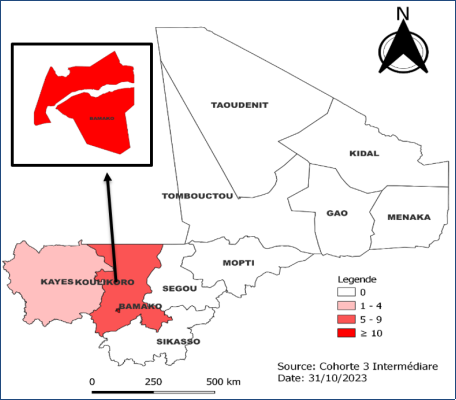
Figure 1. Distribution of human rabies and dog bite cases by region, Mali, 2018-2022.
The Koulikoro region recorded 31.52% (116/368) of bite cases and 37.5% (9/24) of rabies cases, followed by the District of Bamako with 26.08% (96/368) cases of dog bites and 50% (12/24) cases of human rabies (figure 1).
3.2. Pickup
Post-exposure rabies vaccine was administered in 92.93% of bitten patients (Table 2). The lesions were cleaned in 2.45% of our suspected cases (Table 2).
Table 3. Distribution of suspected rabies cases by vaccination post exposition, Mali, 2018-2022.

Vaccination post exposition

Frequence

Pourcentage

Yes

342

92,93

No

26

7,07

Total

368

100

3.3. Associated Factors
The study identified factors associated with the occurrence of rabies, namely the severity of the lesions (p = 0.0001; X=221.38), the lack of management of the lesions (p = 0.0001; X=21.76), the lack of cleaning of the lesions (p = 0.0001; X=16.56), non-consultation in a health facility after the bite (p = 0.001; X=303.55), the absence of post-exposure vaccination (p = 0.001; X=337.71), the notification structure (p = 0.001; X=87.42), the absence of anti-rabies vaccination of biting dogs (p = 0.008; X=7.01); X=4.22 bite lesions (p = 0.039) (Table 4).
Table 4. Crude associations between dog bite cases and rabies occurrence in Mali, 2018-2022.

Variables

Rage

Khi2

p-value

Yes

No

Severity of lesions/number of bites

Serious/2 bites and more

19

6

221,38

0,0001

Less serious/ 1bite

5

338

Non-management of lesions

Yes

20

339

21,76

0,0001

No

4

5

-

No wound cleaning

Yes

20

339

16,56

0,0001

No

4

5

-

No consultation in a health facility after the bite

Yes

3

343

303,55

0,001

No

21

1

-

No vaccination post exposition

Yes

24

2

337,71

0,001

No

0

342

-

Notification Structure

CHU du Point G

6

0

87,42

0,001

Autres

18

344

-

Vaccination of biting dogs

Unvaccinated

24

265

7,01

0,008

Vaccinated

0

79

-

Nature of exposure

Bite

24

292

4,22

0,039

Other

0

52

-

Location of lesions (n=20)*

Head and Upper Limb

12

126

3,40

0,064

Trunk and lower limb

8

197

-

Age/ years

< 15

13

231

1,69

0,193

≥ 15

11

113

-

Sex

Male

16

219

0,08

0,767

Female

8

125

-

* It had 4 missing data.
4. Discussion
4.1. Socio-demographic Characteristics
Our study noted that about two-thirds of bite cases were male. Our result is similar to that of Sylla B. in 2021 in Sikasso, which recorded a sex ratio (male/female) of 1.67 . It is lower than the study carried out by Haleche I et al. in Algeria in 2020 where 85% of cases were male . In the study carried out by Hamidou Christian et al in Niger, 61.54% of the bitten people were male . In our study, men had more contact with the biting dog than women. And the same observation has been made according to the WHO, which finds that in some countries men who are in close contact with animals are more frequently victims of dog bites than women . As for the age of the bitten subjects, our study recorded the majority of bites in children. This result contrasts with that of Hamidou Christian Amadou et al, who found a predominance of adults with an average age of 23 years and 40% for the age group under 15 years . As for the results of Kampo et al, there was a predominance of the 1-20 year age group with 40% of cases , which was lower than that of our study. The difference between our study and those of the authors cited is explained by the size of the samples and the length of the periods of the data concerned.
As for the predominance of children in our observation, it could be explained by the fact that they most often provoke the biting animal either by trying to have fun with the animal, or by fleeing out of fear that encourages the biting animal to attack them. Their naivety does not allow them to take appropriate measures to avoid attacks. According to Sarah Mediouni, children are usually bitten by dogs during play activities .
4.2. Pickup
More than three-quarters of our patients benefited from post-exposure vaccination (92.93% of bitten patients). Our result was superior to those of Brahima Sylla who noted 87.5% administration on the same day, Kampo O et al. who reported an administration rate of 52.25% and no administration in the study of Sawadogo M and Boushad M D. . The differences observed between our study and these different authors could be explained on the one hand by the periods of their studies and the size of the cases concerned and, on the other hand, by the Malian national policy of compulsory vaccination of certain notifiable diseases, including rabies.
4.3. Associated Factors
Severe lesions were most common in rabies cases (19; 95%) compared to less severe ones (5; 15%). This trend was significant with p = 0.0001. It can be explained by the central proximity of the location of the lesions and their nature (bite). These lesions were a factor in the occurrence of rabies. Lesions were not frequently treated in rabies cases (20; 83.33%) compared to those treated (4; 16.67%). This trend was significant with a p = 0.0001. Failure to manage the lesions was a factor associated with the occurrence of rabies. The wounds of rabies cases were not often cleaned (20; 83.33%) compared to those cleaned. This difference was significant with a p = 0.0001. The majority of rabies cases had not consulted a health facility after the bite (21; 87.5%) compared to those who had used a health facility (3; 12.5%). This difference is significant with a p = 0.001. Rabies was linked to the failure to consult a health facility after the bite. Not all rabid cases had received post-exposure vaccination (24; 100%). This non-vaccination after exposure was associated with the occurrence of rabies with a p = 0.001. These trends in care could be explained by its high cost, the average cost of which is estimated according to the WHO at 108 USD, which is financially burdensome for people who earn barely 1 to 2 USD per day . The other health facilities had reported more cases of rabies (18; 75%) than the University Hospital of Point G (6; 25%). This notification was related to the occurrence of rabies with a p = 0.001. This is explained by the pyramidal use of the country's health system, which encourages patients to consult peripheral structures as a first resort. No biting animals in your study were vaccinated (24; 100%). Non-vaccination of biting animals was a factor associated with the occurrence of rabies with a p = 0.008. All lesions were bites (24; 100%). These bites made up a factor for the occurrence of rabies with a p = 0.03. The lesions encountered in our study in rabies cases were mainly located in the head and upper limbs (12; 60%) compared to the trunk and lower limbs (8; 40%). This observation was not significant with a p = 0.064. But it contributes to the severity of the lesions according to the WHO categorization. Our study identified eight factors associated with the occurrence of rabies, while that of Brahima Sylla found no significance in relation to the risk factors for the occurrence of rabies .
5. Conclusion
Our study concerned 24 cases of human rabies out of the 368 cases of dog bites from 2018 to 2022, i.e. a proportion of human rabies occurrence of 6.52%. Children were more bitten with a predominance of men. The District of Bamako has reported more cases of human rabies (12 cases), followed by the Koulikoro region with 9 cases. Factors associated with the occurrence of human rabies were: severity of lesions, lack of management of lesions, failure to clean lesions, non-consultation in a health facility after the bite, failure to administer post-exposure vaccination, reporting structure, lack of rabies vaccination of biting dogs, and bite lesions.
We recommend the vaccination of dogs, adequate care and community awareness in order to reduce the occurrence of rabies.
What we already know about this topic
The proportion of human rabies cases in Mali
What this study adds
Our study produced the socio-demographic characteristics of human rabies cases in Mali.
Our study recognized the factors associated with the occurrence of human rabies in Mali.
The results of our study could be used for other research, other studies.
Abbreviations

CNESS

Committee of the National Center for Ethics for Health and Life Sciences

DGSHP

General Directorate of Health and Public Hygiene

MADO/MADI

Diseases that must be declared immediately

MSDS

Ministry of Health and Social Development

QGIS

Quantum geographical Information System

USD

Unites States Dollar

WHO

World Health Organization

Acknowledgments
Our thanks go to the Ministry of Health and Social Development of Mali, the General Directorate of Health and Public Hygiene of Mali, the management team of the Field Epidemiology Training Program of Mali as well as the staff of the health districts for the collection of additional data.
Author Contributions
Ibrahima Dit Boua Keita: Conceptualization, Data curation, Formal Analysis, Funding acquisition, Investigation, Methodology, Supervision, Validation, Visualization, Writing – original draft, Writing – review & editing
Marietou Traore: Conceptualization, Data curation, Formal Analysis, Investigation, Methodology, Supervision, Validation, Visualization, Writing – original draft
Mamadou Lamine Diabate: Conceptualization, Data curation, Formal Analysis, Investigation, Methodology, Supervision, Validation, Visualization, Writing – original draft
Aly Goita: Conceptualization, Data curation, Formal Analysis, Investigation, Methodology, Supervision, Validation, Visualization, Writing – original draft
Mahamadoun Haroun Maiga: Conceptualization, Data curation, Formal Analysis, Investigation, Methodology, Supervision, Validation, Visualization, Writing – original draft
Gaoudo Sagounta: Conceptualization, Data curation, Formal Analysis, Investigation, Methodology, Supervision, Validation, Visualization, Writing – original draft
Moussa Abdoulaye Diarra: Conceptualization, Data curation, Formal Analysis, Investigation, Methodology, Supervision, Validation, Visualization, Writing – original draft
Issa Berthe: Conceptualization, Data curation, Formal Analysis, Investigation, Methodology, Supervision, Validation, Visualization, Writing – original draft
Kibili Demba Kanoute: Conceptualization, Data curation, Formal Analysis, Investigation, Methodology, Supervision, Validation, Visualization, Writing – original draft
Bakari Kamate: Conceptualization, Data curation, Formal Analysis, Investigation, Methodology, Supervision, Validation, Visualization, Writing – original draft
Dramane Traore: Conceptualization, Data curation, Formal Analysis, Investigation, Methodology, Supervision, Validation, Visualization, Writing – original draft
Karamoko Diallo: Conceptualization, Data curation, Formal Analysis, Investigation, Methodology, Supervision, Validation, Visualization, Writing – original draft
Madou Cisse: Conceptualization, Data curation, Formal Analysis, Investigation, Methodology, Supervision, Validation, Visualization, Writing – original draft
Jidou Ould Adahla: Conceptualization, Data curation, Formal Analysis, Investigation, Methodology, Supervision, Validation, Visualization, Writing – original draft
Mamoutou Diarra: Conceptualization, Data curation, Formal Analysis, Investigation, Methodology, Supervision, Validation, Visualization, Writing – original draft
Oumar Sangho: Project administration, Resources, Software, Writing – original draft
Bouyagui Traore: Project administration, Resources, Software, Writing – original draft
Yacouba Kone: Conceptualization, Data curation, Formal Analysis, Supervision, Validation, Visualization, Writing – original draft
Elhadj Issa Amaguiré Sy: Conceptualization, Data curation, Formal Analysis, Supervision, Validation, Visualization, Writing – original draft
Hanine Keita: Conceptualization, Data curation, Formal Analysis, Project administration, Resources, Software, Supervision, Validation, Visualization, Writing – original draft, Writing – review & editing
Soungalo Diakite: Conceptualization, Data curation, Formal Analysis, Supervision, Validation, Visualization, Writing – original draft
Yacouba Coulibaly: Conceptualization, Data curation, Formal Analysis, Supervision, Validation, Visualization, Writing – original draft, Writing – review & editing
Funding
The study did not receive funding from a partner. However, the costs of the submission to the ethics committee for approval were covered by the AFENET-Mali program.
Conflicts of Interest
The authors declare no conflicts of interest.
References
[1] Fooks AR, Banyard AC, Horton DL, Johnson N, McElhinney LM, Jackson AC. Current status of rabies and prospects for elimination. Lancet Lond Engl. 2014; 384(9951): 1389‑99.
[2] Hampson K, Coudeville L, Lembo T, Sambo M, Kieffer A, Attlan M, et al. Estimating the global burden of endemic canine rabies. PLoS Negl Trop Dis. avr 2015; 9(4): e0003709.
[3] WHO Expert Committee on Rabies, Third Report. World Health Organization; 2021. 215 p.
[4] S. Dao, A. M. Abdillahi, F. Bougoudogo, K. Toure & C. Simbe. Epidemiological aspects of human and animal rabies in urban areas in Bamako, Mali | Epidemiology. Bull Soc Pathol Exot, 2006, 99, 3, 183-186.
[5] Decree No. 06-412/P-RM of September 27, 2006 amending Mali's Decree No. 01-339/P-RM of August 9, 2001.
[6] Dembele JP, Konate I, Cissoko Y, Fofana A, Soumare M, Mfupa YT, et al. Human Rabies at the Point G Hospital Center in Bamako: About Five Observations. Health Sci Dis [Internet]. 2020 Nov 29 [cited 2023 Mar 1]; 21(12). Available on:
[7] General Directorate of Health and Public Hygiene. Dog bite database from 2020 to 2022. DGSHP; 2023.
[8] National Directorate of the Veterinary Service. 2023 Activity Report.
[9] Directorate-General for Population. Update of the 2009 General Population and Housing Census of Mali.
[10] National Directorate of the Veterinary Service. 2022 Activity Report
[11] Sylla B. Factors associated with dog bite in the Sikasso region in 2016 and 2018. Master's thesis in public health. University of Science, Technology and Technology of Bamako, Faculty of Medicine and Odontostomatology. Department of Public Health Studies and Research and Specialties. Mali. 2021. [cited 2023 May 9]; Available on:
[12] Haleche I, Yahia A. Epidemiological study of human and animal rabies in Algeria: Example of the Wilaya of Blida. [Internet] [Thesis]. 2020 [cited 2023 Sep 4]. Available on:
[13] Hamidou Christian Amadou, Karimou Harouna Boureima, Laoualy Manzo, Mamane Salao Soufiano. Rabies in Niger: A Review of a Decade from a "One Health" Perspective. Health Res. Afr.: Vol 3; (6), June 2025, pp 1-6 Available free at
[14] Kampo O, Traore B, Sangho O, Diakite S, Telly N. Study of dog bite cases from January 2017 to October 2019 in the Sikasso Health District, Mali. Mali Public Health. June 30, 2019; 74-8.
[15] Mediouni Sarah. Canine bites and rabies exposures in Nunavik: epidemiology, management and age-related differences. 2020 Mar 24 [cited 2023 Sep 4]; Available on:
[16] Savadogo M., Boushab M.B. Rabies in children: a risk still unknown to exposed populations. Tropical Medicine and Health 2015; 25: 222-224.
[17] World Health Organization. Rabies. June 5, 2024. Press release. Accessed on 09/01/2026 at 18: 34 on
Cite This Article
  • APA Style

    Keita, I. D. B., Traore, M., Diabate, M. L., Goita, A., Maiga, M. H., et al. (2026). Factors Associated with the Occurrence of Human Rabies Cases in Mali, 2018-2022. World Journal of Public Health, 11(3), 374-381. https://doi.org/10.11648/j.wjph.20261103.25

    Copy | Download

    ACS Style

    Keita, I. D. B.; Traore, M.; Diabate, M. L.; Goita, A.; Maiga, M. H., et al. Factors Associated with the Occurrence of Human Rabies Cases in Mali, 2018-2022. World J. Public Health 2026, 11(3), 374-381. doi: 10.11648/j.wjph.20261103.25

    Copy | Download

    AMA Style

    Keita IDB, Traore M, Diabate ML, Goita A, Maiga MH, et al. Factors Associated with the Occurrence of Human Rabies Cases in Mali, 2018-2022. World J Public Health. 2026;11(3):374-381. doi: 10.11648/j.wjph.20261103.25

    Copy | Download

  • @article{10.11648/j.wjph.20261103.25,
      author = {Ibrahima Dit Boua Keita and Marietou Traore and Mamadou Lamine Diabate and Aly Goita and Mahamadoun Haroun Maiga and Gaoudo Sagounta and Moussa Abdoulaye Diarra and Issa Berthe and Kibili Demba Kanoute and Bakari Kamate and Dramane Traore and Karamoko Diallo and Madou Cisse and Jidou Ould Adahla and Mamoutou Diarra and Oumar Sangho and Bouyagui Traore and Yacouba Kone and Elhadj Issa Amaguiré Sy and Hanine Keita and Soungalo Diakite and Yacouba Coulibaly},
      title = {Factors Associated with the Occurrence of Human Rabies Cases in Mali, 2018-2022},
      journal = {World Journal of Public Health},
      volume = {11},
      number = {3},
      pages = {374-381},
      doi = {10.11648/j.wjph.20261103.25},
      url = {https://doi.org/10.11648/j.wjph.20261103.25},
      eprint = {https://article.sciencepublishinggroup.com/pdf/10.11648.j.wjph.20261103.25},
      abstract = {Introduction: Rabies is transmitted by the saliva of infected animals on excoriated skin or mucous membranes. Data from the epidemiological surveillance sub-directorate of the General Directorate of Health and Public Hygiene show an upsurge in cases of human rabies from 3 in 2020 to 10 in 2022 and dog bites from 742 in 2020 to 1702 in 2022, hence this study with the objective of studying the factors associated with the occurrence of the disease in Mali. Methods: This is an analytical cross-sectional study of data from 2018 to 2022, that took place from February 1 to September 30, 2023. Study population was made up of any suspected case of dog of rabies recorded in the DGSHP database from 2018 to 2022. Pearson or Fisher Chi2 tests and a α cut-off of 0.05 allowed comparisons. Results: Cases of dog bites were 368 including 24 cases of human rabies, i.e. a frequency of 6.52%. Factors associated with rabies were: lesion severity (p = 0.0001), lack of lesion management (p = 0.0001), failure to clean lesions (p = 0.0001), failure to visit a health facility after the bite (p = 0.001), lack of post-exposure vaccination (p = 0.001), notification structure (p = 0.001), lack of rabies vaccination of biting dogs (p = 0.008), bite lesions (p = 0.039). Conclusion: Vaccination of dogs, adequate care and community awareness will reduce the occurrence of rabies.},
     year = {2026}
    }
    

    Copy | Download

  • TY  - JOUR
    T1  - Factors Associated with the Occurrence of Human Rabies Cases in Mali, 2018-2022
    AU  - Ibrahima Dit Boua Keita
    AU  - Marietou Traore
    AU  - Mamadou Lamine Diabate
    AU  - Aly Goita
    AU  - Mahamadoun Haroun Maiga
    AU  - Gaoudo Sagounta
    AU  - Moussa Abdoulaye Diarra
    AU  - Issa Berthe
    AU  - Kibili Demba Kanoute
    AU  - Bakari Kamate
    AU  - Dramane Traore
    AU  - Karamoko Diallo
    AU  - Madou Cisse
    AU  - Jidou Ould Adahla
    AU  - Mamoutou Diarra
    AU  - Oumar Sangho
    AU  - Bouyagui Traore
    AU  - Yacouba Kone
    AU  - Elhadj Issa Amaguiré Sy
    AU  - Hanine Keita
    AU  - Soungalo Diakite
    AU  - Yacouba Coulibaly
    Y1  - 2026/09/24
    PY  - 2026
    N1  - https://doi.org/10.11648/j.wjph.20261103.25
    DO  - 10.11648/j.wjph.20261103.25
    T2  - World Journal of Public Health
    JF  - World Journal of Public Health
    JO  - World Journal of Public Health
    SP  - 374
    EP  - 381
    PB  - Science Publishing Group
    SN  - 2637-6059
    UR  - https://doi.org/10.11648/j.wjph.20261103.25
    AB  - Introduction: Rabies is transmitted by the saliva of infected animals on excoriated skin or mucous membranes. Data from the epidemiological surveillance sub-directorate of the General Directorate of Health and Public Hygiene show an upsurge in cases of human rabies from 3 in 2020 to 10 in 2022 and dog bites from 742 in 2020 to 1702 in 2022, hence this study with the objective of studying the factors associated with the occurrence of the disease in Mali. Methods: This is an analytical cross-sectional study of data from 2018 to 2022, that took place from February 1 to September 30, 2023. Study population was made up of any suspected case of dog of rabies recorded in the DGSHP database from 2018 to 2022. Pearson or Fisher Chi2 tests and a α cut-off of 0.05 allowed comparisons. Results: Cases of dog bites were 368 including 24 cases of human rabies, i.e. a frequency of 6.52%. Factors associated with rabies were: lesion severity (p = 0.0001), lack of lesion management (p = 0.0001), failure to clean lesions (p = 0.0001), failure to visit a health facility after the bite (p = 0.001), lack of post-exposure vaccination (p = 0.001), notification structure (p = 0.001), lack of rabies vaccination of biting dogs (p = 0.008), bite lesions (p = 0.039). Conclusion: Vaccination of dogs, adequate care and community awareness will reduce the occurrence of rabies.
    VL  - 11
    IS  - 3
    ER  - 

    Copy | Download

Author Information
  • Ministry of Health and Social Development, Anderamboukane Health District, Menaka, Mali

  • Ministry of Health and Social Development, Reference Health Center of Commune VI, Bamako, Mali

  • Ministry of Health and Social Development, Reference Health Center of Commune VI, Bamako, Mali

  • Ministry of Health and Social Development, Djicoronipara Community Health Center, Bamako, Mali

  • Ministry of Environment, Sanitation and Sustainable Development (MEADD) of Mali, National Directorate of Sanitation and Control of Pollution and Nuisances, Bamako, Mali

  • Ministry of Health and Social Development, National Institute of Public Health, Bamako, Mali

  • Ministry of Health and Social Development, Bla Reference Health Centre, Segou, Mali

  • Ministry of Health and Social Development, Kolokani Reference Health Center, Koulikoro, Mali

  • Ministry of Health and Social Development, Ondougou Community Health Centre, Bandiagara, Mali

  • Ministry of Health and Social Development, Konna Community Health Center, Mopti, Mali

  • Ministry of Health and Social Development, Regional Directorate of Health of Kayes, Kayes, Mali

  • Ministry of Health and Social Development, Taliko-Bougoudani Community Health Center Commune IV, Bamako, Mali

  • Ministry of Livestock and Fisheries of Mali, Regional Directorate of Veterinary Services of the District of Bamako, Bamako, Mali

  • Ministry of Health and Social Development, Regional Directorate of Health of Taoudenit, Taoudenni Mali

  • Ministry of Health and Social Development, Kolondieba Reference Health Centre, Sikasso, Mali

  • Department of Public Health Studies and Research, University of Science, Technology and Technology of Bamako, Bamako, Mali

  • Ministry of Health and Public Hygiene, Bamako, Mali

  • Directorate-General for Health and Public Hygiene, Bamako, Mali

  • Directorate-General for Health and Public Hygiene, Bamako, Mali

  • Directorate-General for Health and Public Hygiene, Bamako, Mali

  • Ministry of Health and Social Development, Sikasso Regional Health Directorate, Sikasso, Mali

  • Ministry of Health and Social Development, Directorate-General for Health and Public Hygiene/National Immunization Centre. Bamako, Mali

  • Abstract
  • Keywords
  • Document Sections

    1. 1. Introduction
    2. 2. Materials and Methods
    3. 3. Results
    4. 4. Discussion
    5. 5. Conclusion
    Show Full Outline
  • Abbreviations
  • Acknowledgments
  • Author Contributions
  • Funding
  • Conflicts of Interest
  • References
  • Cite This Article
  • Author Information