Research Article | | Peer-Reviewed

Extent of ICD-11 Implementation in Teaching Hospitals of North-East Nigeria: A Cross-Sectional Survey of Health Information and ICT Professionals

Received: 2 October 2026     Accepted: 13 October 2026     Published: 21 October 2026
Views:       Downloads:
Abstract

Background: The 11th revision of the International Classification of Diseases (ICD-11) took effect in January 2022, yet there is no published evidence on how far Nigerian hospitals have put it into use. We measured the extent of ICD-11 implementation reported by health information management (HIM) professionals and information and communication technology (ICT) personnel in three teaching hospitals in North-East Nigeria, and examined which respondent and hospital characteristics were associated with substantial implementation. Methods: This was the second objective of a cross-sectional survey of staff in teaching hospitals in Yola, Bauchi and Maiduguri, whose design is described in a companion paper. Twelve Yes/No indicators covering system availability, technical integration, functional readiness and interoperability were summed (range 0-12); a score of 6 or more was defined as substantial implementation. Associations were examined with chi-square tests and binary logistic regression. Results: Data from 475 respondents were analysed (373 HIM, 102 ICT; response 97.7%). A third (32.2%) reported none of the indicators, half (51.2%) reported one to five, and 16.6% (95% confidence interval [CI] 13.6-20.2) reported six or more. Substantial implementation was reported by 20.1% of HIM officers and 3.9% of ICT personnel (p < 0.001), and by 3.8% of respondents in Yola, 31.8% in Bauchi and 10.6% in Maiduguri (p < 0.001). After adjustment, ICT personnel (adjusted odds ratio [AOR] 0.14; 95% CI 0.05-0.42) and staff with 16 or more years of experience (AOR 0.17; 0.06-0.50) were less likely, and staff in Bauchi (AOR 13.57; 4.58-40.19) and Maiduguri (AOR 3.88; 1.25-12.03) more likely than staff in Yola, to report substantial implementation. Conclusion: ICD-11 implementation is at an early stage in these hospitals, with wide differences between professions and hospitals. Joint HIM-ICT planning, integration of the ICD-11 code set into existing systems, training and hospital-specific support are needed. The estimates rest on self-report and a pragmatic cut-off and should be confirmed by audits of actual coding.

Published in World Journal of Public Health (Volume 11, Issue 4)
DOI 10.11648/j.wjph.20261104.13
Page(s) 427-438
Creative Commons

This is an Open Access article, distributed under the terms of the Creative Commons Attribution 4.0 International License (http://creativecommons.org/licenses/by/4.0/), which permits unrestricted use, distribution and reproduction in any medium or format, provided the original work is properly cited.

Copyright

Copyright © The Author(s), 2026. Published by Science Publishing Group

Keywords

ICD-11, Disease Classification, Clinical Coding, Health Information Systems, Implementation, Nigeria

1. Introduction
Accurate and comparable diagnostic information is the foundation of disease surveillance, clinical care, health financing and health policy. For more than a century, countries have used successive revisions of the International Classification of Diseases (ICD), now maintained by the World Health Organization (WHO), to record and compare causes of illness and death . The 10th revision (ICD-10), in use in most countries since the 1990s, is being replaced by the 11th revision (ICD-11), which the World Health Assembly adopted in 2019 and which came into effect on 1 January 2022 .
ICD-11 is not simply an updated list of codes. It was built as a digital classification, with a semantic foundation layer from which the linearisation used for mortality and morbidity statistics is derived, and it allows clinical detail to be added by combining codes (post-coordination) and by using extension codes . A comparative analysis found that ICD-11 has about 38% more precoordinated codes than ICD-10 and that post-coordination can represent about 60% of the codes in the United States clinical modification of ICD-10 without a separate national modification . The revision also introduced new chapters and restructured several existing ones, most visibly in the field of mental health .
Moving to ICD-11 is therefore a change of systems, not of code tables. It requires software that contains and can search the new code set, coders who have been trained to use it, and technical staff who can integrate and maintain it, and WHO has published a transition guide that sets out planning stages for countries and facilities . Early national experience shows both the effort and the payoff. In Iran, coders lost 42% of their productivity in the first three months of coding with ICD-11 and recovered by the fourth month , and coding accuracy was lower with ICD-11 than with ICD-10 (74.2% versus 89.1%), which the authors attributed to coder unfamiliarity and the complexity of extension codes and post-coordination . In Korea, accuracy was 71.6% with ICD-11 against 80.2% with ICD-10 , and clustering of codes was the main source of inconsistency in later field trials . In China’s national pilot, coders reached 82.9% accuracy after a two-day training , and a hospital pilot in West China found the transition smoother than earlier classification upgrades but time-consuming, and dependent on record quality and coder training . In Canada, six coders who completed 60 hours of ICD-11 training averaged 84% on quizzes , and Malaysia has described a planned, standardised rollout in a setting with heterogeneous legacy systems . Evidence from Africa is scarce; one of the few reports we found, from a university hospital in Ghana, applied ICD-11 to retrospective hospital data .
The stakes are particularly high in sub-Saharan Africa, where cause-of-death information is weakest. About two-thirds of deaths worldwide go unregistered , and global assessments have documented the uneven quality of civil registration and vital statistics systems . In Nigeria, civil registration is constrained by inadequate financing and conflicting regulations . Even where deaths are certified, errors matter: reporting an ill-defined condition as the underlying cause is the most damaging certification error . Policy approaches that combine the supply of registration services with demand for them have raised registration rates in several regions . Adopting ICD-11, the classification in which causes of death are now to be reported, is one element of this wider effort.
Nigeria has experience of an earlier transition that is instructive. In a survey of Nigerian hospitals, 88.2% had adopted ICD-10 coding, but barriers persisted, including too few clinical coders and suboptimal clinical documentation (reported as barriers by 74.4% and 91.6%, respectively) and the absence of automation . The health information management workforce has also been described as lacking some information technology competencies , as short of qualified practitioners, and as affected by the deployment of unqualified staff in records roles . These are the conditions into which ICD-11 has to be introduced.
ICD-11 was designed for use in electronic systems, so its implementation depends on the digital environment in which coding takes place. Nigerian studies describe a digital health sector held back by workforce gaps, weak infrastructure and fragmented governance , and hospital-level studies report financial constraints, insufficient ICT resources and unstable power as barriers to electronic health record (EHR) implementation . Implementation science adds that the success of technology programmes depends on organisational readiness, including shared commitment to change , and that programmes that are complex in several domains seldom become mainstream .
Two professions share responsibility for implementation. Health information management (HIM) officers assign and manage codes and know how the classification is applied in practice. Information and communication technology (ICT) personnel are responsible for installing, linking and maintaining the software that holds the code set. Surveys of coders in Iran and Malaysia have assessed knowledge, educational needs, readiness and intention to use ICD-11 , but we are not aware of studies that have compared how HIM and ICT staff view implementation within the same hospitals.
We found no published study that has measured the level of ICD-11 implementation in Nigerian hospitals, and the North-East geopolitical zone is particularly under-studied. The zone comprises Adamawa, Bauchi, Borno, Gombe, Taraba and Yobe States and has been affected by insurgency; in Borno State, a WHO assessment found that of 743 health facilities, 35% were completely destroyed and 29% partially damaged . Routine health information from the zone has also been found to have gaps . The tertiary teaching hospitals in Yola, Bauchi and Maiduguri are the main referral centres of the zone, and the extent to which they have implemented ICD-11 is a test of what can be achieved in a fragile setting.
Our aim was to measure how much ICD-11 implementation HIM officers and ICT personnel report in three teaching hospitals in North-East Nigeria, to compare the two professions, and to find out which characteristics distinguish staff reporting substantial implementation. The same survey also measured EHR adoption, which is reported separately . The results should show hospital managers and planners where support for the transition is most needed.
2. Materials and Methods
2.1. Design and Setting
This paper reports the second objective of a cross-sectional survey of HIM officers and ICT staff in the federal teaching hospitals in Yola (Modibbo Adama University Teaching Hospital, MAUTH), Bauchi (Abubakar Tafawa Balewa University Teaching Hospital, ATBUTH) and Maiduguri (University of Maiduguri Teaching Hospital, UMTH). The setting, sampling and ethical procedures are described in full in the companion paper on EHR adoption and are summarised below. The report follows the STROBE recommendations .
2.2. Participants
From a population of 753 HIM and ICT staff in the three hospitals, a sample of 486 was calculated with Cochran’s formula (95% confidence, 3% margin of error, 10% added for non-response) . It was allocated to hospitals and professions in proportion to staff numbers and drawn by simple random sampling (383 HIM and 103 ICT). Permanently employed staff with at least one year of service who were directly involved in patient data management, coding or EHR support were eligible. Of 486 questionnaires, 475 were returned complete and analysed (97.7%): 373 from HIM officers (97.4%) and 102 from ICT personnel (99.0%).
2.3. Measurement of ICD-11 Implementation
Each respondent completed a structured, self-administered questionnaire in a version for HIM officers or for ICT personnel. The implementation section consisted of 12 Yes/No statements in four domains of three: system availability and deployment; technical integration of ICD-11; functional readiness of ICT systems; and interoperability and data exchange (Tables 1 and 2). The two versions are parallel but differ in wording: the HIM version asks about routine coding work (for example, “ICD-11 codes are integrated into the EHR system used in my facility”) and the ICT version asks about technical deployment (for example, “ICD-11 code libraries are technically integrated into the EHR system”). A further three statements on workforce readiness and institutional support are analysed elsewhere. The number of “Yes” answers (0-12) formed the implementation score, and respondents scoring 0, 1-5, or 6 or more were classed as having none, limited or substantial implementation. Items were drawn from the literature and checked for face and content validity by the supervisors, and the questionnaire was pilot-tested outside the sample; internal consistency of the 12-item implementation scale was assessed with Cronbach’s alpha (equivalent to the Kuder-Richardson 20 coefficient for Yes/No items), and a value of 0.70 or more was considered acceptable . In the pilot test (n = [insert pilot sample size]), Cronbach’s alpha for the 12 items was [insert pilot coefficient]. The questionnaires were delivered in person with repeated follow-up visits.
2.4. Explanatory Variables and Statistical Analysis
The explanatory variables were age (years), gender, educational qualification (secondary or higher), self-reported socio-economic status (low, middle, high), years of experience (1-5, 6-10, 11-15, 16 or more), hospital and professional group. Analysis was done in SPSS version 27. Proportions are given with Wilson 95% confidence intervals. Associations with implementation status (substantial versus not) were tested with the chi-square test, or Fisher’s exact test when expected counts were below five . Binary logistic regression with all explanatory variables entered together gave adjusted odds ratios (AOR), and crude odds ratios for categorical variables were calculated against the first category. With 79 events and 11 parameters (7.2 events per parameter, below the usual guide of 10 ), estimates are imprecise, as discussed under limitations. Two-sided p < 0.05 was taken as significant.
2.5. Ethical Considerations
Approval was obtained from the Research Ethics Committee of Rivers State University (RSU/FBMS/REC/25/429) and the participating hospitals (MAUTHY/HREC/26/433, ATBUTH/REC/26/019 and UMTH/REC/26/021); all participants gave written informed consent and responses were anonymised.
3. Results
3.1. Respondents
The 475 respondents comprised 373 HIM officers and 102 ICT personnel. The full profile of respondents is given in the companion paper ; the distribution of the characteristics examined here is shown by implementation status in Table 3. ICT personnel were younger than HIM officers (mean age 32.3 versus 36.9 years) and less experienced (4.9% versus 27.6% with 16 or more years of service).
3.2. ICD-11 Implementation Indicators
Tables 1 and 2 show the proportion of respondents who answered “Yes” to each of the 12 indicators. No indicator was endorsed by more than 34.9% of HIM officers or 12.7% of ICT personnel. Among HIM officers (Table 1), the most commonly reported indicators were the integration of ICD-11 codes into the EHR system (34.9%), the ability of the EHR to support ICD-11 coding without manual processes (32.2%) and the prompt implementation of ICD-11 updates (33.8%), and the least commonly reported were the existence of functional ICT systems in the facility (9.9%), adequate ICT infrastructure for electronic record management (11.3%) and a standardised health data exchange (17.4%). Averaged across the three indicators in each domain, the proportion of HIM officers answering “Yes” was 33.6% for technical integration, 26.7% for system availability and deployment, 22.8% for interoperability and data exchange, and 13.8% for functional readiness of ICT systems.
Among ICT personnel (Table 2), endorsement was lower for every domain: 10.5% for technical integration, 9.2% for interoperability and data exchange, 6.5% for system availability and deployment and 6.5% for functional readiness. The most commonly reported indicator was the technical integration of ICD-11 code libraries into the EHR system (12.7%), and the least commonly reported were adequate server, network and hardware infrastructure and technical capability of the EHR to support ICD-11 workflows (each 4.9%). Calculated from the item-level counts, respondents reported a mean of 2.91 of the 12 indicators among HIM officers, 0.98 among ICT personnel and 2.49 overall.
Table 1. ICD-11 implementation indicators reported by HIM officers (n = 373).

Indicator

HIM officers (n = 373) Yes, n (%)

System availability and deployment

1. EHR systems required for ICD-11 coding are available

105 (28.2)

2. Computer systems are accessible for routine ICD-11 coding

95 (25.5)

3. System downtime rarely disrupts ICD-11 coding work

99 (26.5)

Technical integration of ICD-11

4. ICD-11 codes are integrated into the EHR system

130 (34.9)

5. EHR supports ICD-11 coding without reliance on manual processes

120 (32.2)

6. ICD-11 updates are implemented promptly

126 (33.8)

Functional readiness of ICT systems

7. The facility has functional ICT systems

37 (9.9)

8. ICT infrastructure is adequate for electronic record management

42 (11.3)

9. System features support correct documentation for ICD-11 coding

75 (20.1)

Interoperability and data exchange

10. ICD-11 coded data can be shared electronically across departments

103 (27.6)

11. EHR system supports standardised health data exchange

65 (17.4)

12. ICD-11 data generated are suitable for reporting and analysis

87 (23.3)

EHR, electronic health record. Each indicator was a Yes/No statement; the 12 indicators were summed to give the implementation score.
Table 2. ICD-11 implementation indicators reported by ICT personnel (n = 102).

Indicator

ICT personnel (n = 102) Yes, n (%)

System availability and deployment

1. EHR systems required for ICD-11 implementation are fully deployed

7 (6.9)

2. Server, network and hardware infrastructure adequately support ICD-11 operations

5 (4.9)

3. System uptime is sufficient to sustain ICD-11 activities

8 (7.8)

Technical integration of ICD-11

4. ICD-11 code libraries are technically integrated into the EHR system

13 (12.7)

5. System configurations support ICD-11 coding requirements

10 (9.8)

6. ICD-11 system updates and patches are routinely implemented

9 (8.8)

Functional readiness of ICT systems

7. EHR system is technically capable of supporting ICD-11 workflows

5 (4.9)

8. System functionality minimises errors during ICD-11 coding

8 (7.8)

9. ICT systems support structured clinical documentation for ICD-11 use

7 (6.9)

Interoperability and data exchange

10. EHR system supports interoperable exchange of ICD-11 data

9 (8.8)

11. ICD-11 data can be transmitted across internal and external systems

9 (8.8)

12. Standard data exchange protocols are used for ICD-11 information

10 (9.8)

3.3. Level of ICD-11 Implementation
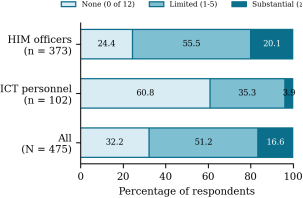
Overall, 153 respondents (32.2%; 95% CI 28.2-36.5) reported none of the 12 indicators, 243 (51.2%; 46.7-55.6) reported one to five, and 79 (16.6%; 13.6-20.2) reported six or more and were classed as having substantial implementation (Table 3, Figure 1). Substantial implementation was reported by 75 of 373 HIM officers (20.1%; 95% CI 16.4-24.5) and by 4 of 102 ICT personnel (3.9%; 1.5-9.7), whereas 60.8% of ICT personnel reported none of the indicators, compared with 24.4% of HIM officers. The difference between the two groups was significant (χ² = 15.13, p < 0.001).
Figure 1. ICD-11 implementation status by professional group (% of respondents).
Table 3. ICD-11 implementation status by professional group.

Implementation status

HIM officers n (%)

ICT personnel n (%)

Total n (%)

None (0 of 12)

91 (24.4)

62 (60.8)

153 (32.2)

Limited (1-5 of 12)

207 (55.5)

36 (35.3)

243 (51.2)

Substantial (6-12 of 12)

75 (20.1)

4 (3.9)

79 (16.6)

Mean number of indicators reported*

2.91

0.98

2.49

Calculated from the item-level counts in Tables 1 and 2. Substantial implementation: 95% CI 13.6-20.2 (total), 16.4-24.5 (HIM) and 1.5-9.7 (ICT).
3.4. Characteristics Associated with Substantial ICD-11 Implementation
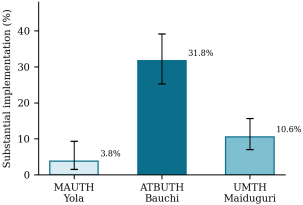
In bivariate analysis (Table 4), substantial implementation differed significantly by age group (χ² = 8.00, p = 0.046), years of experience (χ² = 11.36, p = 0.010), hospital (χ² = 46.02, p < 0.001) and professional group (χ² = 15.13, p < 0.001). The proportion rose from 12.1% among those aged 30 years or younger to 32.0% among those aged 51 years or older. It was highest among staff with 11-15 years of experience (22.6%) and lowest among those with 16 or more years (7.4%). Across hospitals the figure was 3.8% at MAUTH, 31.8% at ATBUTH and 10.6% at UMTH (Figure 2). Gender, educational qualification and socio-economic status were not significantly associated with implementation. The share of ICT personnel was similar in the three hospitals (24.5% at MAUTH, 18.2% at ATBUTH and 22.6% at UMTH), so differences between hospitals are not explained by differences in professional mix.
Table 4. Association between respondent characteristics and ICD-11 implementation status.

Characteristic

n

Substantial n (%)

Not substantial n (%)

χ²

p-value

Gender

0.10

0.759

Male

227

39 (17.2)

188 (82.8)

Female

248

40 (16.1)

208 (83.9)

Age (years)

8.00

0.046

≤30

157

19 (12.1)

138 (87.9)

31-40

209

34 (16.3)

175 (83.7)

41-50

84

18 (21.4)

66 (78.6)

≥51

25

8 (32.0)

17 (68.0)

Educational qualification

0.340†

Secondary

19

1 (5.3)

18 (94.7)

Higher

456

78 (17.1)

378 (82.9)

Socio-economic status

3.15

0.207

Low

37

10 (27.0)

27 (73.0)

Middle

377

59 (15.6)

318 (84.4)

High

61

10 (16.4)

51 (83.6)

Years of experience

11.36

0.010

1-5

114

17 (14.9)

97 (85.1)

6-10

98

19 (19.4)

79 (80.6)

11-15

155

35 (22.6)

120 (77.4)

≥16

108

8 (7.4)

100 (92.6)

Facility

46.02

<0.001

MAUTH, Yola

106

4 (3.8)

102 (96.2)

ATBUTH, Bauchi

170

54 (31.8)

116 (68.2)

UMTH, Maiduguri

199

21 (10.6)

178 (89.4)

Professional group

15.13

<0.001

HIM officers

373

75 (20.1)

298 (79.9)

ICT personnel

102

4 (3.9)

98 (96.1)

Total

475

79 (16.6)

396 (83.4)

†Fisher’s exact test (expected count below 5), so no χ² is shown. Degrees of freedom: 1 for gender, education and professional group; 3 for age and years of experience; 2 for socio-economic status and hospital.
Figure 2. Proportion of respondents reporting substantial ICD-11 implementation by hospital (bars show 95% confidence intervals).
Table 5 presents the logistic regression. Four characteristics remained independently associated with substantial implementation in the adjusted model. ICT personnel had lower odds than HIM officers (AOR 0.14; 95% CI 0.05-0.42). Compared with MAUTH, respondents at ATBUTH had markedly higher odds (AOR 13.57; 95% CI 4.58-40.19) and respondents at UMTH had higher odds (AOR 3.88; 95% CI 1.25-12.03). Compared with staff with 1-5 years of experience, those with 16 or more years had lower odds (AOR 0.17; 95% CI 0.06-0.50), while each additional year of age was associated with 6% higher odds (AOR 1.06; 95% CI 1.02-1.10). Gender, educational qualification, socio-economic status and 6-10 or 11-15 years of experience were not significant. The crude estimates for hospital and for experience differed from the adjusted ones: the crude odds ratio for UMTH compared with MAUTH was 3.01 (95% CI 1.00-9.01), that for 11-15 years of experience was 1.66 (95% CI 0.88-3.15), and that for 16 or more years was 0.46 (95% CI 0.19-1.11).
Table 5. Binary logistic regression of factors associated with substantial ICD-11 implementation (N = 475).

Characteristic

Crude OR (95% CI)

p-value

Adjusted OR (95% CI)

p-value

Age (per year)

1.04 (1.01-1.07)

0.010

1.06 (1.02-1.10)

0.007

Gender (ref: Male)

Female

0.93 (0.57-1.50)

0.759

0.80 (0.46-1.42)

0.449

Educational qualification (ref: Secondary)

Higher

3.71 (0.49-28.24)

0.205

3.82 (0.48-30.71)

0.207

Socio-economic status (ref: Low)

Middle

0.50 (0.23-1.09)

0.081

0.56 (0.22-1.41)

0.220

High

0.53 (0.20-1.43)

0.209

0.70 (0.22-2.22)

0.547

Years of experience (ref: 1-5)

6-10

1.37 (0.67-2.82)

0.388

1.14 (0.49-2.64)

0.767

11-15

1.66 (0.88-3.15)

0.118

0.78 (0.34-1.76)

0.543

≥16

0.46 (0.19-1.11)

0.083

0.17 (0.06-0.50)

0.001

Facility (ref: MAUTH, Yola)

ATBUTH, Bauchi

11.87 (4.15-33.92)

<0.001

13.57 (4.58-40.19)

<0.001

UMTH, Maiduguri

3.01 (1.00-9.01)

0.049

3.88 (1.25-12.03)

0.019

Professional group (ref: HIM officers)

ICT personnel

0.16 (0.06-0.45)

<0.001

0.14 (0.05-0.42)

<0.001

OR, odds ratio; CI, confidence interval; ref, reference category. Outcome: substantial implementation (6 or more of 12 indicators) versus not. Adjusted estimates come from one model that includes every characteristic (79 events; 11 parameters). Crude estimates for categories were derived from the counts in Table 4 relative to the reference group; the crude age estimate comes from a single-variable model.
4. Discussion
This study measured the level of ICD-11 implementation in three tertiary hospitals in North-East Nigeria after the classification came into effect in January 2022. Its main finding is that implementation was at an early stage: about one in three respondents reported none of 12 implementation indicators, half reported only one to five, and one in six (16.6%) reported six or more. Implementation differed sharply between professions, with HIM officers about five times as likely as ICT personnel to report substantial implementation (20.1% versus 3.9%), and between hospitals, from 3.8% to 31.8%. These differences persisted after adjustment for age, experience and other characteristics.
Direct comparison with other countries is limited because no other study has used the same indicators, but the overall picture is consistent with the stage reached elsewhere. Several countries that have reported on ICD-11 have done so within national pilots or field trials with dedicated training, including China , Iran , Korea , Malaysia and Canada , and even there coders lost productivity at first and accuracy was lower than with ICD-10 . Our results suggest that in the Nigerian hospitals studied, many of the technical prerequisites are not yet reported to be in place, so that the problems seen in those settings, such as coding accuracy, cannot yet be studied. They also echo Nigeria’s experience with ICD-10. A national survey found that although most hospitals had adopted ICD-10, too few coders, poor documentation and the absence of automation obstructed its use . Our study suggests that the same constraints, together with the need for new code sets and training, now apply to ICD-11.
The pattern across indicators is informative. The best-reported indicators concerned the technical integration of ICD-11 into the EHR (codes integrated, manual processes not needed, updates applied promptly), reported by about one-third of HIM officers, and the worst-reported concerned functional readiness of the underlying ICT systems and standardised data exchange. This suggests that where ICD-11 has been implemented, it has been added to existing systems, but that the infrastructure and exchange standards that would make it reliable are not yet in place. It is consistent with reports from Malaysia that a standardised rollout must contend with heterogeneous legacy systems , and with Nigerian reports of weak infrastructure and unstable power . Even the best-reported indicator was endorsed by only about one-third of HIM officers and one in eight ICT personnel.
Two features of our measurement need to be considered when this result is read alongside general EHR adoption. In a companion analysis of the same survey, about three-quarters of respondents rated general EHR adoption as high , whereas fewer than 30% of HIM officers answered “Yes” to the indicator that the EHR systems required for ICD-11 coding were available. The two results are not contradictory in principle, because a hospital can have an EHR that is not configured for ICD-11, and the lowest-scoring domain in the adoption analysis was ICD-11 compatibility. But the two instruments differ: general adoption was rated on a five-point agreement scale, whereas implementation was a strict Yes/No judgement, and agreement scales are prone to acquiescence. The indicator wording in the HIM version also asks about “my facility”, which respondents in different units may answer differently. The level of implementation we report should therefore be read as a conservative, perception-based estimate and not as an exact count of facilities with ICD-11 in operation.
The gap between HIM officers and ICT personnel is the second main finding. ICT personnel were much less likely to report substantial implementation (AOR 0.14) after adjustment for age, experience and hospital, and 60.8% of them reported none of the indicators. Several explanations are possible, and our data cannot separate them. The ICT version of the questionnaire asked about technical deployment in stricter terms (for example, “fully deployed”, “adequately support”), so ICT staff may have applied a higher standard than HIM officers, who may count partial or manual use. ICT staff are the people who know whether code libraries are actually integrated, and in the companion analysis their rating of the corresponding adoption item included a large proportion of neutral answers (41.2%) . Whatever the explanation, the finding is practically important, because implementation requires both groups to act together. Surveys of coders elsewhere have focused on coders’ knowledge, educational needs and readiness ; our results suggest that the readiness of the ICT side, and the shared understanding between the two groups, deserve equal attention. The Nigerian literature points to weaknesses in the information technology skills of HIM professionals , which would make joint planning with ICT staff more, not less, important.
The difference between hospitals was larger than any other. Respondents at ATBUTH had about 14 times the adjusted odds of reporting substantial implementation as respondents at MAUTH, and those at UMTH had about four times the odds. The unadjusted odds ratio for UMTH (3.01) shows that this is not an artefact of adjustment. We did not measure what distinguishes the hospitals, so we can only suggest where to look. Leadership commitment, funding, in-house training and technical support are repeatedly identified as determinants of technology implementation , and training in particular has been central to the national experiences with ICD-11 in China and Canada . A further observation from the same survey is that MAUTH, which had the lowest ICD-11 implementation, had the highest level of general EHR adoption (90.6% high) . This is a comparison of only three hospitals and we draw no causal conclusion from it, but it is consistent with the idea that a functioning EHR does not by itself mean ICD-11 is in use.
Age and experience had opposite associations after adjustment. Each additional year of age was associated with higher odds of substantial implementation (AOR 1.06), whereas staff with 16 or more years of experience had much lower odds than those with 1-5 years (AOR 0.17). Age and years of experience are strongly correlated, so the two coefficients must be read together: among staff of the same length of service, older staff were more likely to report implementation, and among staff of the same age, those with the longest service were least likely. The explanation is not obvious. One possibility is that staff with the longest service are in supervisory or administrative roles with less direct involvement in coding, and so report fewer implementation activities; another is that experienced coders who are most used to ICD-10 face a steeper change, which would be consistent with the unfamiliarity cited to explain lower coding accuracy with ICD-11 in Iran and Korea . Neither was tested here. Gender, educational qualification and socio-economic status were not associated with implementation; the lack of association with education is likely to reflect little variation, since 96.0% of respondents had a diploma or higher qualification.
These findings have several practical implications. First, planning for the transition should be joint, with HIM and ICT units sharing responsibility and a common set of indicators; WHO’s transition guide provides a framework for this . Second, systems must be upgraded to contain and support the ICD-11 code set before training can have its full effect, because trained coders cannot code in a system that lacks the classification. Third, training should be planned with the productivity loss in mind: coders in Iran lost about 42% of their productivity in the first three months and recovered by the fourth , and structured training programmes have been used successfully in Canada and China . Fourth, because ICD-11 is the classification for cause-of-death reporting, its implementation is a part of the broader task of strengthening civil registration and vital statistics . Finally, hospital-specific diagnostic assessments of the kind suggested by the hospital differences above are needed, since a uniform national approach is unlikely to fit both the hospital that reported the most implementation and the one that reported the least.
The study has strengths and limitations. Its strengths are a high response rate (97.7%), proportionate sampling across hospitals and professions, the inclusion of both HIM and ICT staff, and an indicator-based measure that describes specific features of implementation and not a general impression. The limitations are as follows. The cross-sectional design cannot show causal direction. All data were self-reported and were not verified by system audit or review of coded records, so we do not know how accurately ICD-11 is being used; self-report may be affected by social desirability and common-method bias . The two questionnaire versions differ in wording, which complicates comparison of the groups. The classification into substantial implementation at six of 12 indicators is a pragmatic cut-off equal to half of the scale, not a validated threshold, and “substantial” should not be read as complete implementation; the results at other cut-offs were not examined. The model had 7.2 events per parameter, below the usual recommendation of 10 , and some categories were sparse (one respondent with secondary education reported substantial implementation, and four respondents at MAUTH did), so the odds ratios, in particular the large ones for ATBUTH and UMTH, are imprecise and may be overestimated. Only three hospitals were studied, chosen because they had EHR systems, so hospital differences cannot be separated from other unmeasured characteristics, and the results may not apply to hospitals without EHR systems, to secondary or primary facilities, or to other zones. Finally, insecurity in parts of the zone may have affected the willingness of respondents to report deficiencies. Future studies should combine surveys with audits of coded records and system configurations, use qualitative methods to explore why hospitals differ, and follow hospitals over time.
5. Conclusion and Recommendation
ICD-11 implementation in these three tertiary hospitals in North-East Nigeria is at an early stage. About one respondent in three reported none of 12 implementation indicators, only one in six reported six or more, and ICT personnel were far less likely than HIM officers to report substantial implementation. Implementation differed greatly between hospitals, with Bauchi reporting the highest level and Yola the lowest, and it was also associated with age and length of service.
We recommend that: (i) hospital managements establish joint HIM-ICT ICD-11 implementation teams in each hospital, with agreed indicators and timelines; (ii) existing EHR platforms be upgraded to include the ICD-11 code set, search functions and standard data-exchange protocols; (iii) role-specific training for coders and ICT staff be provided, with allowance for the temporary fall in productivity during the transition; (iv) the Federal Ministry of Health, State Ministries of Health and professional bodies issue practical facility-level guidance and technical support, and give priority to hospitals reporting the least implementation; and (v) future research combine audits of coded records and system configuration with qualitative work to explain differences between hospitals, and track implementation over time.
Abbreviations

AOR

Adjusted Odds Ratio

ATBUTH

Abubakar Tafawa Balewa University Teaching Hospital

CI

Confidence Interval

EHR

Electronic Health Record

HIM

Health Information Management

ICD-10 / ICD-11

International Classification of Diseases, 10th / 11th Revision

ICT

Information and Communication Technology

MAUTH

Modibbo Adama University Teaching Hospital

OR

Odds Ratio

SD

Standard Deviation

STROBE

Strengthening the Reporting of Observational Studies in Epidemiology

UMTH

University of Maiduguri Teaching Hospital

WHO

World Health Organization

Acknowledgments
The authors are grateful to the three hospital managements for access, and to the HIM officers and ICT staff who completed the questionnaire.
Author Contributions
Minkailu Abubakar Amadu: Conceptualization, Data curation, Formal Analysis, Investigation, Methodology, Writing – original draft
Anthony Ike Wegbom: Conceptualization, Methodology, Validation, Supervision, Writing – review & editing
Peter Uduak Augustine: Methodology, Validation, Supervision, Writing – review & editing
Queen Desmond Atuzie: Data curation, Formal Analysis, Validation, Writing – original draft
Priscillia Nyekpunwo Ogbonda: Data curation, Formal Analysis, Validation, Writing – review & editing
Boma Judith Fubara: Data curation, Investigation
Rose Ibifaka Blakk: Data curation, Investigation
Data Availability Statement
The data supporting the findings of this study are available from the corresponding author on reasonable request.
Conflicts of Interest
The authors declare no conflicts of interest.
References
[1] World Health Organization (WHO). International Classification of Diseases 11th Revision (ICD-11) [Internet]. Geneva: World Health Organization; 2019. Available from:
[2] Harrison, J. E., Weber, S., Jakob, R., Chute, C. G. ICD-11: an international classification of diseases for the twenty-first century. BMC Medical Informatics and Decision Making. 2021; 21(Suppl 6): 206.
[3] Chute, C. G., Çelik, C. Overview of ICD-11 architecture and structure. BMC Medical Informatics and Decision Making. 2021; 21(Suppl 6): 378.
[4] Fung, K. W., Xu, J., Bodenreider, O. The new International Classification of Diseases 11th edition: a comparative analysis with ICD-10 and ICD-10-CM. Journal of the American Medical Informatics Association. 2020; 27(5): 738-746.
[5] Reed, G. M., First, M. B., Kogan, C. S., Hyman, S. E., Gureje, O., Gaebel, W., et al. Innovations and changes in the ICD-11 classification of mental, behavioural and neurodevelopmental disorders. World Psychiatry. 2019; 18(1): 3-19.
[6] World Health Organization (WHO). ICD-11 implementation or transition guide, version 1.05. Geneva: World Health Organization; 2019. Available from:
[7] Azadmanjir, Z., Sheikhtaheri, A., Zarei, J., Golpira, R., Bakhshandeh, H., Vahedi, A., Hashemi, N. A study on initial productivity trend in the transition of the ICD-10 to ICD-11 morbidity coding in Iran. Informatics in Medicine Unlocked. 2024; 44: 101440.
[8] Zarei, J., Golpira, R., Hashemi, N., Azadmanjir, Z., Meidani, Z., Vahedi, A., et al. Comparison of the accuracy of inpatient morbidity coding with ICD-11 and ICD-10. Health Information Management Journal. 2025; 54(1): 14-24.
[9] Lee, H., Kim, S. Impact of the ICD-11 on the accuracy of clinical coding in Korea. Health Information Management Journal. 2023; 52(3): 221-228.
[10] Lee, H., Lee, Y. A Korean field trial of ICD-11 classification under practical clinical coding rules to clarify the reasons for inconsistencies. Health Information Management Journal. 2025; 54(3): 303-310.
[11] Zhang, M., Wang, Y., Jakob, R., Su, S., Bai, X., Jing, X., et al. Methodologies and key considerations for implementing the International Classification of Diseases-11th revision morbidity coding: insights from a national pilot study in China. Journal of the American Medical Informatics Association. 2024; 31(5): 1084-1092.
[12] Ming, X., Wei, H., Zhou, D., Tao, J., Qian, B., Li, H., Hu, J. ICD-11 pilot in West China: feasibility evaluation and implications for future implementation. Scientific Reports. 2026; 16: 25328.
[13] Eastwood, C. A., Southern, D. A., Doktorchik, C., Khair, S., Cullen, D., Boxill, A., et al. Training and experience of coding with the World Health Organization's International Classification of Diseases, Eleventh Revision. Health Information Management Journal. 2023; 52(2): 92-100.
[14] Ooi, E. C. W., Isa, Z. M., Manaf, M. R. A., Ahmad Fuad, A. S., Sidek, H. F., Mustapa, M. N., et al. From data collection to downstream data use: Malaysia's experience with ICD-11. Health Information Management Journal. 2025; 54(3): 325-332.
[15] Ampah, B. A., Opoku, D. A., Sackeya, E., Ayisi-Boateng, N. K., Konadu, E., Addae, M., et al. Profiling disease patterns using ICD-11 at a university hospital in Ghana: a retrospective analysis of cross-sectional data from 2018 to 2021. Health Science Reports. 2026; 9(4): e72366.
[16] AbouZahr, C., de Savigny, D., Mikkelsen, L., Setel, P. W., Lozano, R., Nichols, E., Notzon, F., Lopez, A. D. Civil registration and vital statistics: progress in the data revolution for counting and accountability. The Lancet. 2015; 386(10001): 1373-1385.
[17] Mikkelsen, L., Phillips, D. E., AbouZahr, C., Setel, P. W., de Savigny, D., Lozano, R., Lopez, A. D. A global assessment of civil registration and vital statistics systems: monitoring data quality and progress. The Lancet. 2015; 386(10001): 1395-1406.
[18] Maduekwe, N. I., Banjo, O. O., Sangodapo, M. O. The Nigerian civil registration and vital statistics system: contexts, institutions, operation. Social Indicators Research. 2017; 134: 651-674.
[19] Gamage, U. S. H., Adair, T., Mikkelsen, L., Mahesh, P. K. B., Hart, J., Chowdhury, H., et al. The impact of errors in medical certification on the accuracy of the underlying cause of death. PLOS ONE. 2021; 16(11): e0259667.
[20] Suthar, A. B., Khalifa, A., Yin, S., Wenz, K., Ma Fat, D., Mills, S. L., et al. Evaluation of approaches to strengthen civil registration and vital statistics systems: a systematic review and synthesis of policies in 25 countries. PLOS Medicine. 2019; 16(9): e1002929.
[21] Adeleke, I. T., Ajayi, O. O., Jimoh, A. B., Adebisi, A. A., Omokanye, S. A., Jegede, M. K. Current clinical coding practices and implementation of ICD-10 in Africa: a survey of Nigerian hospitals. American Journal of Health Research. 2015; 3(1-1): 38-46.
[22] Adeleke, I. T., Lawal, A. H., Adio, R. A., Adebisi, A. A. Information technology skills and training needs of health information management professionals in Nigeria: a nationwide study. Health Information Management Journal. 2015; 44(1): 30-38.
[23] Makinde, O. A., Mami, M. I., Oweghoro, B. M., Oyediran, K. A., Mullen, S. Investing in health information management: the right people, in the right place, at the right time. Health Information Management Journal. 2016; 45(2): 90-96.
[24] Ojo, A. I. Repositioning health information management practice in Nigeria: suggestions for Africa. Health Information Management Journal. 2018; 47(3): 140-144.
[25] Adeleke, I. T., Suleiman-Abdul, Q. B., Aliyu, A., Ishaq, I. A., Adio, R. A. Deploying unqualified personnel in health records practice: role substitution or quackery? Implications for health services delivery in Nigeria. Health Information Management Journal. 2019; 48(3): 152-156.
[26] Ravi, N., Thomas, C., Odogwu, J. How to reload and upgrade digital health to serve the healthcare needs of Nigerians. Frontiers in Digital Health. 2023; 5: 1225092.
[27] Babatope, A. E., Adewumi, I. P., Ajisafe, D. O., Adepoju, K. O., Babatope, A. R. Assessing the factors militating against the effective implementation of electronic health records (EHR) in Nigeria. Scientific Reports. 2024; 14: 31398.
[28] Weiner, B. J. A theory of organizational readiness for change. Implementation Science. 2009; 4: 67.
[29] Greenhalgh, T., Wherton, J., Papoutsi, C., Lynch, J., Hughes, G., A'Court, C., Hinder, S., Fahy, N., Procter, R., Shaw, S. Beyond adoption: a new framework for theorizing and evaluating nonadoption, abandonment, and challenges to the scale-up, spread, and sustainability of health and care technologies. Journal of Medical Internet Research. 2017; 19(11): e367.
[30] Zarei, J., Hadianfard, A., Sheikhtaheri, A. Preparation for the implementation of the International Classification of Diseases 11th revision: a survey on clinical coders' knowledge of ICD-11, educational needs, and readiness to accept new roles: a cross-sectional study. Health Science Reports. 2025; 8(3): e70453.
[31] Ooi, E. C. W., Isa, Z. M., Manaf, M. R. A., Ahmad Fuad, A. S., Ahmad, A., Mustapa, M. N., et al. Development and validation of the intention to use the ICD-11 questionnaire in the Malaysian medical records context. PLOS ONE. 2024; 19(9): e0308403.
[32] World Health Organization (WHO). Full impact of devastated health services in north-eastern Nigeria revealed by WHO report [Internet]. Geneva: World Health Organization; 2016 Dec 14. Available from:
[33] Bhattacharya, A. A., Umar, N., Audu, A., Felix, H., Allen, E., Schellenberg, J. R. M., Marchant, T. Quality of routine facility data for monitoring priority maternal and newborn indicators in DHIS2: a case study from Gombe State, Nigeria. PLOS ONE. 2019; 14(1): e0211265.
[34] Amadu, M. A., Augustine, P. U., Atuzie, Q. D., Ogbonda, P. N., Fubara, B. J., Blakk, R. I., Wegbom, A. I. Electronic health record adoption among health information management and ICT staff in tertiary hospitals in North-East Nigeria: level and associated factors. Manuscript under peer review at Biomedical Statistics and Informatics (manuscript ID 2750186).
[35] von Elm, E., Altman, D. G., Egger, M., Pocock, S. J., Gøtzsche, P. C., Vandenbroucke, J. P. The Strengthening the Reporting of Observational Studies in Epidemiology (STROBE) statement: guidelines for reporting observational studies. The Lancet. 2007; 370(9596): 1453-1457.
[36] Cochran, W. G. Sampling techniques. 3rd ed. New York: John Wiley & Sons; 1977.
[37] Krejcie, R. V., Morgan, D. W. Determining sample size for research activities. Educational and Psychological Measurement. 1970; 30(3): 607-610.
[38] Tavakol, M., Dennick, R. Making sense of Cronbach's alpha. International Journal of Medical Education. 2011; 2: 53-55.
[39] Kim, H.-Y. Statistical notes for clinical researchers: chi-squared test and Fisher's exact test. Restorative Dentistry & Endodontics. 2017; 42(2): 152-155.
[40] Peduzzi, P., Concato, J., Kemper, E., Holford, T. R., Feinstein, A. R. A simulation study of the number of events per variable in logistic regression analysis. Journal of Clinical Epidemiology. 1996; 49(12): 1373-1379.
[41] Podsakoff, P. M., MacKenzie, S. B., Lee, J.-Y., Podsakoff, N. P. Common method biases in behavioral research: a critical review of the literature and recommended remedies. Journal of Applied Psychology. 2003; 88(5): 879-903.
Cite This Article
  • APA Style

    Amadu, M. A., Augustine, P. U., Atuzie, Q. D., Ogbonda, P. N., Fubara, B. J., et al. (2026). Extent of ICD-11 Implementation in Teaching Hospitals of North-East Nigeria: A Cross-Sectional Survey of Health Information and ICT Professionals. World Journal of Public Health, 11(4), 427-438. https://doi.org/10.11648/j.wjph.20261104.13

    Copy | Download

    ACS Style

    Amadu, M. A.; Augustine, P. U.; Atuzie, Q. D.; Ogbonda, P. N.; Fubara, B. J., et al. Extent of ICD-11 Implementation in Teaching Hospitals of North-East Nigeria: A Cross-Sectional Survey of Health Information and ICT Professionals. World J. Public Health 2026, 11(4), 427-438. doi: 10.11648/j.wjph.20261104.13

    Copy | Download

    AMA Style

    Amadu MA, Augustine PU, Atuzie QD, Ogbonda PN, Fubara BJ, et al. Extent of ICD-11 Implementation in Teaching Hospitals of North-East Nigeria: A Cross-Sectional Survey of Health Information and ICT Professionals. World J Public Health. 2026;11(4):427-438. doi: 10.11648/j.wjph.20261104.13

    Copy | Download

  • @article{10.11648/j.wjph.20261104.13,
      author = {Minkailu Abubakar Amadu and Peter Uduak Augustine and Queen Desmond Atuzie and Priscillia Nyekpunwo Ogbonda and Boma Judith Fubara and Rose Ibifaka Blakk and Anthony Ike Wegbom},
      title = {Extent of ICD-11 Implementation in Teaching Hospitals of North-East Nigeria: A Cross-Sectional Survey of Health 
    Information and ICT Professionals},
      journal = {World Journal of Public Health},
      volume = {11},
      number = {4},
      pages = {427-438},
      doi = {10.11648/j.wjph.20261104.13},
      url = {https://doi.org/10.11648/j.wjph.20261104.13},
      eprint = {https://article.sciencepublishinggroup.com/pdf/10.11648.j.wjph.20261104.13},
      abstract = {Background: The 11th revision of the International Classification of Diseases (ICD-11) took effect in January 2022, yet there is no published evidence on how far Nigerian hospitals have put it into use. We measured the extent of ICD-11 implementation reported by health information management (HIM) professionals and information and communication technology (ICT) personnel in three teaching hospitals in North-East Nigeria, and examined which respondent and hospital characteristics were associated with substantial implementation. Methods: This was the second objective of a cross-sectional survey of staff in teaching hospitals in Yola, Bauchi and Maiduguri, whose design is described in a companion paper. Twelve Yes/No indicators covering system availability, technical integration, functional readiness and interoperability were summed (range 0-12); a score of 6 or more was defined as substantial implementation. Associations were examined with chi-square tests and binary logistic regression. Results: Data from 475 respondents were analysed (373 HIM, 102 ICT; response 97.7%). A third (32.2%) reported none of the indicators, half (51.2%) reported one to five, and 16.6% (95% confidence interval [CI] 13.6-20.2) reported six or more. Substantial implementation was reported by 20.1% of HIM officers and 3.9% of ICT personnel (p Conclusion: ICD-11 implementation is at an early stage in these hospitals, with wide differences between professions and hospitals. Joint HIM-ICT planning, integration of the ICD-11 code set into existing systems, training and hospital-specific support are needed. The estimates rest on self-report and a pragmatic cut-off and should be confirmed by audits of actual coding.},
     year = {2026}
    }
    

    Copy | Download

  • TY  - JOUR
    T1  - Extent of ICD-11 Implementation in Teaching Hospitals of North-East Nigeria: A Cross-Sectional Survey of Health 
    Information and ICT Professionals
    AU  - Minkailu Abubakar Amadu
    AU  - Peter Uduak Augustine
    AU  - Queen Desmond Atuzie
    AU  - Priscillia Nyekpunwo Ogbonda
    AU  - Boma Judith Fubara
    AU  - Rose Ibifaka Blakk
    AU  - Anthony Ike Wegbom
    Y1  - 2026/10/21
    PY  - 2026
    N1  - https://doi.org/10.11648/j.wjph.20261104.13
    DO  - 10.11648/j.wjph.20261104.13
    T2  - World Journal of Public Health
    JF  - World Journal of Public Health
    JO  - World Journal of Public Health
    SP  - 427
    EP  - 438
    PB  - Science Publishing Group
    SN  - 2637-6059
    UR  - https://doi.org/10.11648/j.wjph.20261104.13
    AB  - Background: The 11th revision of the International Classification of Diseases (ICD-11) took effect in January 2022, yet there is no published evidence on how far Nigerian hospitals have put it into use. We measured the extent of ICD-11 implementation reported by health information management (HIM) professionals and information and communication technology (ICT) personnel in three teaching hospitals in North-East Nigeria, and examined which respondent and hospital characteristics were associated with substantial implementation. Methods: This was the second objective of a cross-sectional survey of staff in teaching hospitals in Yola, Bauchi and Maiduguri, whose design is described in a companion paper. Twelve Yes/No indicators covering system availability, technical integration, functional readiness and interoperability were summed (range 0-12); a score of 6 or more was defined as substantial implementation. Associations were examined with chi-square tests and binary logistic regression. Results: Data from 475 respondents were analysed (373 HIM, 102 ICT; response 97.7%). A third (32.2%) reported none of the indicators, half (51.2%) reported one to five, and 16.6% (95% confidence interval [CI] 13.6-20.2) reported six or more. Substantial implementation was reported by 20.1% of HIM officers and 3.9% of ICT personnel (p Conclusion: ICD-11 implementation is at an early stage in these hospitals, with wide differences between professions and hospitals. Joint HIM-ICT planning, integration of the ICD-11 code set into existing systems, training and hospital-specific support are needed. The estimates rest on self-report and a pragmatic cut-off and should be confirmed by audits of actual coding.
    VL  - 11
    IS  - 4
    ER  - 

    Copy | Download

Author Information
  • Department of Public Health Sciences, Rivers State University, Port Harcourt, Nigeria

  • School of Health Information Management, University of Uyo Teaching Hospital, Akwa Ibom, Nigeria

  • Department of Public Health Sciences, Rivers State University, Port Harcourt, Nigeria

  • Department of Public Health Sciences, Rivers State University, Port Harcourt, Nigeria

  • Department of Public Health Sciences, Rivers State University, Port Harcourt, Nigeria

  • Department of Public Health Sciences, Rivers State University, Port Harcourt, Nigeria

  • Department of Public Health Sciences, Rivers State University, Port Harcourt, Nigeria